Understanding Expiration Dates in American Culture
- Alisha
- Feb 14, 2018
- 14 min read
Abstract:
Expiration dates have become an important part of food culture in grocery stores in America, but how exactly do these dates influence culture? Expiration dates have changed the idea of what is “edible” in America, and consumers and stores are more willing to throw out edible food items, which contributes to the burgeoning problem of food waste. Researching this topic will provide information to the anthropological community about the cultural treatment of food edibility.
This essay will cover several aspects of expiration dates and how they are treated in American culture. I will include information from the viewpoint of consumers and stores that sell food items. This information will draw from Kroger, a large, commercial grocery chain, as well as consumers and small-businesses (i.e. Georgetown Market, Daily Table, etc.). I intend to analyze information from several pre-existing sources, and conduct interviews of my own regarding the treatment and opinions of expiration dates within the local sphere.
Understanding Expiration Dates in American Culture
When shopping for groceries, people have varying methods for choosing which items they are willing to purchase. Some shoppers focus on price or brand of the item, but others will decide whether or not to buy a product by looking at the date on the label. Expiration dates are often confused with shelf life. Shelf life refers to the quality of the food item, and expiration dates are a guideline for food safety, often unrelated to a date when the food item is no longer acceptable for consumption.
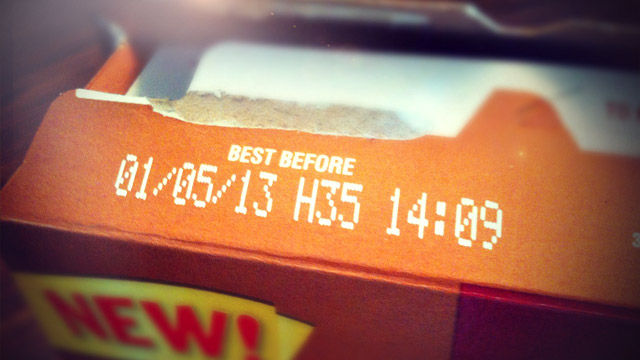
Some foods grow in value by their age. Wine and some spirits are valued differently based on their date, and cheeses are treated differently based on how long they spent in the aging process. Other foods are not looked at so kindly based on the date shown on the packaging. Expiration dates are often hard to find. Some are written clearly in black ink within a specified space. Others are an impression stamped on the box, only visible when the light shines in a certain direction. Still others have no semblance of an identifiable date, and consumers must look up how the date code translated to a point in time when the food seemingly becomes inedible.
In a 2013 report by the National Resources Defense Council, Emily Leib, Deputy Director of the Harvard Law School Center for Health Law and Policy Innovation, and other authors discuss what exactly expiration dates mean. Their final conclusion? Expiration dates are a poorly regulated indication of the quality of food, which give no real estimate of its true edibility. The United States Department of Agriculture tells a completely different story on their website, “Open Dating” (use of a calendar date as opposed to a code) on a food product is a date stamped on a product’s package to help the store determine how long to display the product for sale. It can also help the purchaser to know the time limit to purchase or use the product at its best quality. It is not a safety date” (USDA 2014). The USDA describes four different types of dates that can be found on food packaging. A "Sell-By" date is a recommended date indicating when the store should sell the product or remove it from the shelves. A "Best if Used By” date indicates when a food item is at peak quality. A "Use-By" date is the last date recommended for the use of the product. "Closed or coded dates" are packing numbers for use by the manufacturer (USDA 2014). Going back to the report from the NRDC, we can see that expiration dates have different state regulations, whereas the USDA is only reporting on federal recommendations. This leads to much confusion in the minds of consumers, many of which believe the date on the package is an indication of when the food item is no longer edible.
In an interview with Miriam Cross, Researcher-Reporter for Kiplinger Personal Finance, Leib discussed how the misconceptions about expiration dates effect consumers, “A study out of the United Kingdom found 20% of total household food waste was caused just by confusion over dates— not because food went bad or was inedible. And over a billion dollars’ worth is thrown away annually in the United States before it even gets to consumers because of expiration dates” (Cross 2014:12). Consumers at this point are not educated on what expiration dates really mean. Emily Leib and others in the study by the NRDC believe consumers are massively contributing to food waste with perfectly edible food because of their confusion. Eleanor Smith, Senior Associate Editor for The Atlantic, estimates just how much food is wasted in her article, “Spoiler Alert,” “[E]very year, about 40 percent of all food in the U.S. goes uneaten; a typical four-person household discards roughly $1,500 worth” (Smith 2014). To compound the confusion, regarding federal and state laws, the USDA and other sources indicate, the FDA does not require food firms to place expiration dates on food products other than infant formulas. The manufacturer is allowed to determine where and if a date label is placed on the packaging. Some states have laws regarding expiration dates, but they all vary. Many, but not all, states require dairy, eggs, and shellfish to be labeled with an expiration date. Other categories such as potentially hazardous foods, perishable foods, and meat and poultry are required to be labeled, but very few states have laws about those. The lack of standard state regulation for expiration dates in the United States causes confusion for many stores and consumers, and leaves them with little education about exactly what those dates are trying to communicate about the edibility of food products.
Even if manufacturers did decide to place an expiration date on the label, customers infrequently check the product’s date when making a purchase. A study by Michael Tsiros and Carrie M. Heilman, both Professors of Marketing and Commerce at the University of Miami and the University of Virginia, respectively, finds that customers check expiration dates for products that expire more frequently, such as milk and chicken, but less frequently expiring products are less likely checked (Tsiros and Heilman 2005:13-15). In my own research, I found that many consumers at Georgetown Market, a health food store in Indianapolis, and a Bloomington Kroger, do not check expiration dates on the day of purchase. Only 24% of the participants of the study looked at any of their product expiration dates, and .02% checked all of their product expiration dates. However, about 62% will check after purchase if the product has been sitting in their cupboard or in their refrigerator for three months or more (Roberts 2015). One article in USA Today states, “Some 91% of consumers occasionally throw food away based on the "sell by" date out of a mistaken concern for food safety even though none of the date labels actually indicate food is unsafe to eat” and “An estimated $900,000,000 worth of expired food is removed from the supply chain every year. While not all of this is due to confusion, a casual survey of grocery store workers found that even employees themselves do not distinguish among different kinds of dates” (USA Today 2013:2).
Adding even more confusion to this already broken system, grocery stores are not federally required to remove expired items from shelves. There are absolutely no laws in place to keep those items out of stores. When asked about knowledge of this lack of laws, two managers from two different stores had the same response. Andrew Montieth, the head grocery manager at Georgetown Market, and Darrin Giggy, the store manager of a Bloomington, Indiana Kroger, were not surprised to hear about Indiana State and federal laws, but had the same word-for-word response, “We are still responsible for best practice” (Roberts 2015 Montieth & Giggy) Both stores are said to be diligent in their practices of removing expired products from their shelves. This author can personally attest to the validity of Andrew Montieth’s claims at Georgetown Market, being the one in charge of removing those products. Every month, a list is made of the individually, hand-checked food items expiring the following month. Every day those items are removed according to their expiration date, and every week, frequently expiring items are rechecked. Refrigerated items are listed and rechecked every week. This maintains the shelves and insures that no expired items are left behind.
Fortunately, there are people who have come to understand the misconceptions about expiration dates, and attempt to use that to their advantage and the advantage of others. One man, Doug Rauch, former executive of Trader Joe’s and present owner of the Daily Table is attempting to educate others about expired products. The Daily Table will provide past-date foods and products the manufacturers did not think was worth selling. Rauch has many personal opinions about expiration dates, but in the end, he simply wants to sell food at reasonable prices for those who could not otherwise afford it. In an interview with Hope Reeves, writer for The New York Times, Rauch says about expiration date confusion, “One, we're uneducated; and two, because it's so inexpensive we can afford to throw away food. I think that we need to become better informed. At Daily Table, our approach is to create an environment that is warm, friendly, bright and the average person walking in would not in any way think that they were getting anything but first-rate product” (Reeves 2013). Rauch isn’t the only one in the business of selling expired yet edible foods.
Other stores, called “salvage grocery stores,” have existed for decades. According to Ashley Chaifetz, Research Assistant in the Department of Public Policy at the University of North Carolina at Chapel Hill, a salvage grocery story may sell items “at a below-market price: past-date or nearly-past-date foods, commercial-sized items, holiday and seasonal foods, failed products (sometimes merely character-themed), items that never made it to market, less-than-perfect fruits and vegetables (that supermarkets no longer want to display), items that did not sell well in a particular city or region, items with misspelled or misshapen labels, overrun products, and products in dented boxes” (Chaifetz 2014). Their foods run much cheaper than the typical grocery store or health food market, but they don’t necessarily cater to a specific audience. Jamie Eastridge, manager of the Banana Box in Newton, North Carolina says their customers are “everyone from homeless to doctors and lawyers. It seems like we get a lot folks in the medical field — they don’t even look at the dates” (Chaifetz 2014). By using knowledge of expiration dates, these stores are cutting down on food waste at the hand of the manufacturer and providing healthy food items at similar prices to low-cost junk food for communities that may not otherwise be able to afford a healthy diet.
Other groups of people use the practice of cooking and providing expired, yet edible, foods to others. Food Not Bombs is an organization that stemmed from a movement called freeganism. Freegans are typically seen as part of the anti-consumerism movement, but their daily practice is to forage for and reclaim any discarded edible foods. Steven Averett, writer and Content Director for Waste Age, writes, “The movement's roots trace to the early '80s. Adherents -- generally well-educated members of the middle class who are not homeless -- organize online using sites like meetup.com and freegan.info to plan "trash tours" and share favorite trash spots. They compare their lifestyle to that of traditional hunter/gatherers, only instead of gathering wild berries and nuts, they're gathering slightly wilted lettuce and expired tofu dogs” (Averett 2007:66). Food Not Bombs uses the same philosophy, by growing their own food and accepting donations from companies and organizations, they provide free vegan and vegetarian meals to the homeless, hungry, and needy. The Indianapolis branch of Food Not Bombs has a unique view of expiration dates and expired foods that deviates from a typical consumer. When asked how their ideas about food differ, one member said, “We see it as wasteful to just throw something away because a date says so. There has been fear in the past because people got sick eating spoiled food, but that doesn’t mean the [expiration] date is always right. The [manufacturer] puts those on there to cover their butts legally. We just want to show people that our senses work just as well to find spoiled food as their dates do” (Roberts 2015 Food Not Bombs-Indianapolis).
This group wants to use their resources to teach others about expiration dates. Since everyone in the community is welcome to volunteer and join in on their freegan feasts, they take time out of their events to talk to others about what is safe and healthy to eat and how expiration dates play into that. This particular branch of Food Not Bombs feels strongly about how large manufacturers and food providers use expiration dates in order to increase sales and continuously rotate product. They feel the food could be put to better use, and the overproduction and waste of foods contributes to hunger and the carbon footprint in the United States. Another member, who works regularly in the field of food politics chimed in, “Expiration dates are sometimes a good estimate, but food can become inedible way before or way after the date. Many cases of sickness from food items today occur before the expiration date has passed. This is why we like to educate community members. You should always look, smell, and even taste a small sample before consuming in order to practice safe consumption, regardless of the expiration date” (Roberts 2015 Food Not Bombs-Indianapolis).
In American culture, expiration dates have changed the way people view the edibility of food. Organizations and businesses like Food Not Bombs and The Daily Table seek to challenge the taboo of salvaged and expired food. The majority of Americans cannot overcome their ideas about dumpster diving or eating food past its expiration date. Many have accepted the hegemony of manufacturer placed expiration dates, and have developed a cultural taboo about eating foods past that date. Steven Pinker, Johnstone Family Professor of Psychology at Harvard University, wrote about how these taboos may develop in The Moral Instinct, “Much of our recent social history, including the culture wars between liberals and conservatives, consists of the moralization or amoralization of particular kinds of behavior. Even when people agree that an outcome is desirable, they may disagree on whether it should be treated as a matter of preference and prudence or as a matter of sin and virtue” (Pinker 2008:2). In the case of expiration dates, consumers and manufacturers took note of illness due to spoiled foods. When manufacturers began using expiration dates as an indication of edibility, some consumers followed out of fear of illness. Over time, more consumers began to accept expiration dates, and eventually people began to agree that only food consumed before the expiration date would produce desirable outcomes. According to Pinker’s idea of morality, only eating food before the expiration date is the utilitarian standard of what would result in the greatest good for the greatest number. Now, those who eat expired food are seen as dirty, unhealthy, or immoral. Dumpster-diving is affiliated with the homeless or poor, and also with thievery.
Other theories come into play when understanding why American culture is so dependent on expiration dates. The Framing Effect, a form of bias, is utilized by many manufacturers and health organizations by promoting the regular use of expiration dates. Despite the unpredictability of food spoilage, the expiration date is touted as the sole indicator of edibility for large quantities of food product. The manufacturers and health organizations place a frame around expired foods as a health hazard, whether or not the individual product is, in fact, expired. People tend to avoid negative frames such as the one surrounding expired foods, and flock to positive frames in order to secure a positive outcome. Many of the manufacturers and health organizations operate under the school of utilitarianism. They believe expiration dates help provide the greatest good for the greatest number of people. In this case, expiration dates help ensure good health for Americans by alerting them to the quality of food products over time. Michael Pollan, Professor of Journalism at the UC Berkeley Graduate School of Journalism, promotes eating foods that expire. He does not mention expiration dates in his book Food Rules, but uses framing to place foods that expire in a positive set of outcomes. He writes, “The more processed a food is, the longer the shelf life, and the less nutritious it typically is. Real food is alive - and therefore it should eventually die” (Pollan 2009:15). This chapter creates positive framework for the edibility of foods outside of the expiration date, claiming that foods that expire are actually a positive addition to the diet.
Beyond the promoters of expiration dates, consumers and food providers hold a false belief of government regulation of expiration dates. As mentioned before, the two managers from Georgetown Market and the Bloomington Kroger kept their shelves free of expired food, citing “best practice” as the reasoning behind their policies. This idea of best practice is due to a fear of retaliation on the part of the consumer. Consumers that follow Pinker’s moral evolution or the Framing Effect will also view particular stores in a certain way due to the food on their shelves. If a consumer repeatedly finds expired food on a store’s shelves, they will associate the store with the same negative bias that they viewed the food. This could lead to the loss of a customer, or even worse, legal retaliation.
Overall, the things that shape the American culture’s views of expiration dates span from objective to subjective on an ever changing scale. By drawing from information in the government, health, large and small business, and domestic spheres, expiration dates are seen in the mainstream as a fairly accurate estimate of the edibility of food products. Due to this assumption, consumers are more willing to throw out food that is still edible in order to follow what they assume is a correct indicator of when the food will spoil. Although the regulation of expiration dates is inconsistent, if apparent at all, education about those expiration dates is sparse. However, companies and organizations, such as The Daily Table an Food Not Bombs, strive to increase education about expiration dates and decrease food waste by selling or using expired foods to benefit those who typically cannot afford healthy food.
On a subjective scale, American culture has evolved to associate expired food with illness, disease, and poverty. Therefore, eating expired food carries with it a sense of immorality. This immorality has stemmed from a history of documented illness in conjunction with spoiled food. Since Expiration dates are believed to be an accurate indicator of when food spoils, a taboo developed and ideas of morality about food evolved. Consumers, along with other supporters of following expiration dates have placed expired foods in a negative frame and follow the utilitarian belief that providing expiration dates and consuming food before those dates is what is best for the greatest number of people.
By studying expiration dates on an anthropological scale, Americans and anthropologists alike can develop a better understanding of why expired foods are considered taboo and instantly inedible. Environmental and medical anthropologists should be especially concerned considering the effects that expired yet edible foods have on American culture and the environment. Cultural anthropologists in the field of Food Studies may find research about expiration dates interesting as an indicator of edibility, especially in comparison to cultures where expiration dates are ignored or nonexistent.
Overall, food is an important and defining part of culture. Every culture’s beliefs and practices concerning food shape the way the rest of the culture functions. By continuing and deepening the study of expiration dates, anthropologists can discover more about American culture and how it operates and identifies itself with food.
Bibliography:
Averett, Steven. “Back Alley Buffet.” Waste Age, November 1, 2007, 66.
Chaifetz, Ashley. "Salvage Grocery Stores: The Next Big Thing In Food Isn't Even New."
Modern Farmer. December 2, 2014. Accessed April 13, 2015.
Cross, Miriam. “Stop Wasting Food and Money.” 68, no. 2 (2014): 12. Accessed February
21, 2015. EbscoHOST.
“Did You Know That a Store Can Sell Food past the Expiration Date?” U.S. Food and Drug
Administration. January 26, 2015. Accessed February 22, 2015.
“Expiration Date Confusion Proves Costly.” USA Today, December 1, 2013, 2.
“Expired Products Stay on Shelves.” Consumer Reports 78, no. 3 (2013): 8-9. Accessed
February 21, 2015. EbscoHOST.
“Food Product Dating.” United States Department of Agriculture. December 22, 2014.
Accessed February 22, 2015. http://www.fsis.usda.gov/wps/portal/fsis/topics/food-
Leib, Emily B et al. “The Dating Game: How Confusing Food Date Labels Lead to Food Waste
in America.” New York City: Natural Resources Defense Council, 2013. Accessed April 15,
Pinker, Steven. "The Moral Instinct." The New York Times Magazine, January 13, 2008, 1-8.
Pollan, Michael. "Eat Only Foods That Will Eventually Rot." In Food Rules: An Eater's Manual.
New York: Penguin Books, 2009.
Reeves, Hope. “‘In the Old Days, You’d Smell the Milk’” New York Times Magazine,
November 10, 2013, 16.
Roberts, Alisha. Interview with Andrew Monteith. Tape Recording. Indianapolis, Indiana. April
10, 2015.
Roberts, Alisha. Interview with Darrin Giggy. Tape Recording. Bloomington, Indiana. April 12,
2015.
Roberts, Alisha. Interview with Food Not Bombs-Indianapolis. Tape Recording. Indianapolis,
Indiana. April 17, 2015.
Roberts, Alisha. Survey of Georgetown Market customers. Survey. Indianapolis, Indiana. April
11, 2015.
Roberts, Alisha. Survey of Kroger customers. Survey. Bloomington, Indiana. April 12, 2015.
Smith, Eleanor. “Spoiler Alert.” Atlantic, June 1, 2014, 26.
Tsiros, Michael, and Carrie M. Heilman. “The Effect of Expiration Dates and Perceived Risk on
Purchasing Behavior in Grocery Store Perishable Categories.” Journal of Marketing, no. 69
(April 2005): 114–129.


Comments